It’s been a while since I’ve added a post but am resolved not to put out anything that might be found boring or waste of time to those who chose to read on. It is with that sincere hope I add this one . . .
In my former life, I followed my chosen career path into the field of clinical psychology because of my fascination with the human mind – the indelible influence of past experiences reflected in one’s decisions, roles assumed, patterns developed in relationships, etc. That same passionate inquisitiveness has always guided my evaluation of fictional characters as well as become my guide in my own literary endeavors – each character must think, behave, relate to others, grow, and BE thoroughly consistent with their true nature. And it takes great skill to preserve the consistency and also allow him or her to change. It’s become one of my greatest challenges as a writer of fiction.
An example of an author who has, in my opinion, admirably achieved this is Dorothy Sayers in her Lord Peter Wimsey Mystery series, written in the later 1920’s and 30’s. Peter, a veteran of WWI and younger son of a wealthy English peer, and without need of supporting himself, finds mental satisfaction and amusing distraction by solving murders. He takes nothing else in his life seriously, particularly not the series of casual relationships with the women he accumulates and with whom he is soon bored.
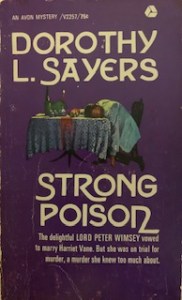
In Strong Poison, Peter, in his late 30’s, becomes involved in the murder trial of Harriet Vane, a young writer of detective stories, who’s accused of murdering her former lover. Peter is not only interested in finding the true killer and assuring Harriet’s acquittal, he falls for her. At their first meeting, while she remains the accused with little hope of escaping the gallows, he proposes marriage. In the end, Peter naturally solves the case, but instead of throwing herself into the arms of her hero as he’d counted on, the girl rejects him – her gratitude has become a formidable barrier in his continued pursuit of her.
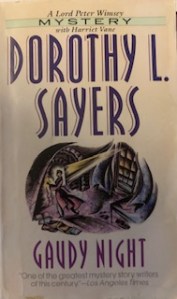
Twice, later in the series – Have His Carcass and Gaudy Nights, Harriet finds herself involved in a murder, Peter arrives on the scene, and together solve the case. What is fascinating, however, is not the unraveling of clues, it’s the gradual, subtle change in Peter permeating his relationship with her until, by the end of Gaudy Nights (a lengthy read), Harriet agrees to marry him. Sayers goes about it delicately, intelligently, ingenuously, credibly and . . . it’s absolute genius! She follows with Busman’s Honeymoon that takes the couple through the early weeks of their marriage, in which both parties assess what transpired in bringing them to that point and what is continuing to evolve between them while coping with the corpse found in their honeymoon cottage.
If you haven’t read these books and, like me, delight in good character development, I highly recommend them, especially as a good summer read! I’d be interested in your take . . .
 The Weight of Stories